
Disclosure: This site contains affiliate links for products and services we recommend. Read our Terms & Conditions for more information. If you make a purchase through these links, at no extra cost to you, we will earn a small commission (for which we are eternally grateful).
One of the best ways to talk about difficult subjects is to use art, so it’s no wonder that animators return to the subject of war again and again. There are so many different perspectives to tell animated war movies from, and an almost infinite number of ways in which to do so, be it through hand drawings, CGI, stop motion animation, or even rotoscope photography.
So it comes as little surprise that there is a wealth of animated war films to enjoy, if that is the right word. Perhaps a better term would be to appreciate.
In any case, many of them are poignant, beautiful, nuanced and emotional, from the wildly fantastical to the bleakly realistic. These are my choices for some of the best animated war movies that you should seek out.

I have split this list of animated war films into two sections: Studio Ghibli war films, and all the rest.
This is mainly because you can’t talk about animated movies – about war or otherwise – without talking about Studio Ghibli. They’ve had a huge impact on global cinema, even before they entered the western mainstream with a bang with the international release of Spirited Away, and their impact on popular culture cannot be understated.
So they get their own section. Congratulations!
Wondering where to watch?
We have done our best to list buying – and sometimes viewing options – for the following films. But as streaming services vary greatly from country to country and we probably don’t live where you do, we just can’t cover them all. However, we 100% recommending checking if the show is available on your favourite viewing platform(s).
As digital nomads we don’t always have access to some of the MANY options only available in countries like the USA and UK. So outside, of the powerhouses like Netflix, Hulu and Amazon Prime, these are the services we recommend:
• Shudder: This one is for all our fellow horror fans out there!
• KweliTV: Find 500+ Black TV shows, films, documentaries and more from around the world
• Viki: A must for those who love East Asian cinema. An absolute treasure trove of Korean, Japanese and Chinese media.
• Mubi: Perfect for anyone who enjoys indie and arthouse cinema from around the world. If you feel overwhelmed, they do a film of the day recommendation.
• SovietMovies: If you haven’t gotten into Russian cinema, you’re missing out! They have a great range of old and new Russian films available with many subtitle options. And, they offer a lifetime, unlimited subscription option for $100!
With that having been said, here are some options to find where to watch or buy in your country:
• uNoGS will tell you in what countries a film or show is available on Netflix.
• JustWatch & PlayPilot can help you find additional streaming and buying options in several countries around the world. Those located in the USA and UK can also use ReelGood.
Need to unlock content?
Virtual Private Networks (VPNs) allow you to unlock content from around the world. AND they keep your information safe while browsing online (essential if you use public WiFi).
We literally couldn’t do our jobs without a VPN. We personally use & recommend ExpressVPN
Studio Ghibli Films About War
War is one of the main recurring themes of Studio Ghibli’s films. If you’re interested in animated war movies and haven’t see any of these, you need to remedy that ASAP. Oscar-winning co-founder Hayao Miyazaki, who has written and directed so many of Studio Ghibli’s feature-length animations that he is the de facto face of the studio to many, has put the theme of war and conflict into enough of his animations that they have their own separate section on this list. So here are their most war-oriented productions.

Grave of the Fireflies (1988)
The most directly war-related Studio Ghibli film, Grave of the Fireflies is also probably the darkest of the studio’s output. Set during the final months of World War II, the film follows a young brother and sister as they try to survive the hardships of war, and their increasingly dangerous circumstances.
Be warned: this Studio Ghibli war movie pulls no punches. It can accurately be described as a tearjerker. But that does not take away from the fact that the studio lends its characteristically beautiful and sensitive touch to what could otherwise be a brutally depressing social drama. It’s the toughest Ghibli film to watch, but it is worth it.
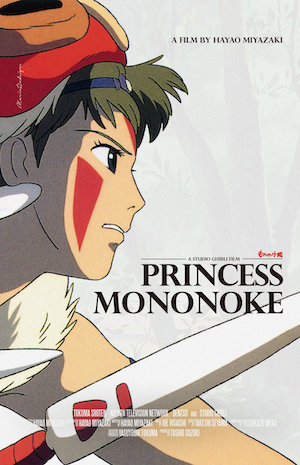
Princess Mononoke (1997)
When brave warrior Prince Ashitaka is infected with a curse while fighting a demon, he must leave his homeland and search for a cure. After heading west he finds himself caught up in a battle between the humans of the Irontown and the forest gods, who are aided by San, a seemingly feral human girl.
The war present here is humans vs nature, with the civilisation of man quickly encroaching on the natural world and, in most cases, destroying it to fuel its barbarous needs. Director Hayao Miyazaki’s environmentalism rears its head most strongly in this period fantasy, as the humans of Irontown leave a barren waste in their wake as they search for riches that they can extract from the forest and also the power of the gods that reside within. The parallels of humans using up natural resources in the pursuit of wealth can be made with any capitalist ventures in recent history and still appear relevant. Plus, it looks gorgeous.
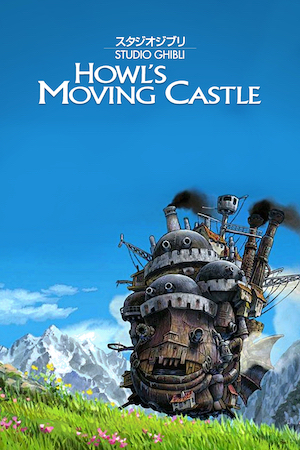
Howl’s Moving Castle (2004)
Following a run-in with the elusive magician Howl, hat-maker Sophie is cursed into early old-age by the jealous Witch of the Wastes. Now she has to find a way to remove it, and that means tracking down Howl and his moving castle. But will he be able – or willing – to help?
That’s the main plot, but the spectre of war looms large over the events of this film. The main kingdoms of this world are constantly fighting, with airships raining down both bombs and demoralising propaganda on everyone. Howl himself is desperately trying to avoid being drafted into the fighting by the King, and his anger at just even seeing the gun-toting airships boils up frequently. Even though the plot focuses mainly on Sophie and her relationship with Howl and the other supporting characters, this animated war movie still effectively conveys a feeling of what it’s like to try and live in a city experiencing the fear of the threat of conflict.
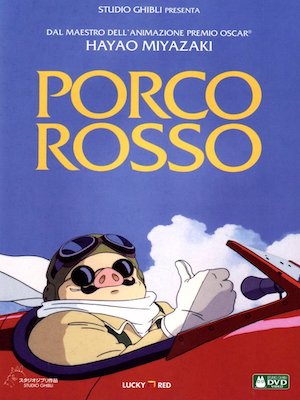
Porco Rosso (1992)
In the early 1930’s, dynamic flying ace Porco Rosso is a freelance bounty hunter, and uses the skills he employed during World War I to defend ships from pirate air attacks. Unfortunately, he’s been transformed into a pig! Or at least, his head is (the rest of him is still human enough to fly a plane really well). After being shot down and presumed dead by an arrogant American fighter pilot, Porco must then fix his plane, and avoid being captured by the Italian police, who have a warrant for his arrest.
Hayao Miyazaki, once again on writing and directing duties, sets this film in a very specific time and place in the real world. Porco himself has very strong feelings about the emerging fascist government of Italy (which would become one of the Axis powers during World War II), saying he’d “rather be a pig than a fascist”, leading some to view this movie as anti-war propaganda. The theory has even been posited that Porco has transformed into a pig due to his feelings of guilt and negativity towards the military. In any case, while Porco Rosso doesn’t take place during open conflict, being set in the 1930’s means that war isn’t very far away, in either direction of time, and Porco’s demeanour, especially as he recalls a memory from WWI, (shown in flashback in the film), carries a lot of weight.
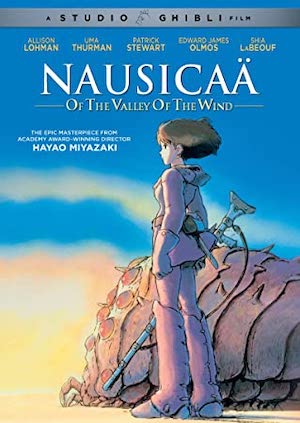
Nausicaä of the Valley of the Wind (1984)
Two warring nations in a post apocalyptic world are trying to eradicate each other. One has a weapon that originally caused the war that turned the land into a toxic jungle one thousand years ago, the other is using giant insects that inhabit the toxic jungle to destroy the cities of its rival. Can Princess Nausicaä find a way to stop them before they cause more destruction, and find a way for humans and the jungle to co-exist?
Technically, this isn’t strictly speaking a Studio Ghibli war movie, as it predates the founding of Studio Ghibli by a year. But it IS Hayao Miyazaki at the helm, with a classic environmentalist anti-war drama! This animated war movie set the thematic template for many a Miyazaki film to come. The art style for the characters will be familiar to fans of Ghibli films, but the rest is … a little more 80’s, shall we say. But in a good way, I promise.
Buy Nausicaä of the Valley of the Wind
Best Non-Studio Ghibli Animated War Movies

When the Wind Blows (1986)
An elderly British couple, Jim and Hilda Bloggs, go about their daily lives as the tensions of an impending nuclear war begin to mount. Meaning to weather the conflict, just as they both survived World War II, Jim builds a shelter made of doors from inside their house and stockpiles supplies in preparation for the oncoming nuclear holocaust. And then the nuclear bomb comes.
In a word, this film is heavy. Not that you wouldn’t expect something like that from an animated film about nuclear war. But When the Wind Blows shows us a very human reaction to absolute devastation, and the Bloggs’ naivety in the face of such a bleak future is a tender thing to watch.
If you’re nervous about the possible after effects of nuclear fallout, this may not be the film for you. Or it might be just the thing you need. It’s a very powerful film. Just make sure you have something lighthearted to follow it up with.

The Iron Giant (1999)
October 1957: as the Cold War quietly rages, an object falls from the sky and crashes into the ocean just off the coast of Maine, USA. That object happens to be a 50 foot tall robot, and he is discovered the next night by nine year old Hogarth Hughes. The robot is timid and playful, and they eventually become friends. But before too long, a paranoid government agent comes to investigate, and with a giant alien robot wandering around, it’s only so long before the army gets involved, and then it’s military vs robot.
The Iron Giant has become something of a cult classic, or at the very least an under appreciated gem. And rightly so – co-written and directed by Brad Bird (who would go on to do Pixar’s The Incredibles and Ratatouille), the movie is exciting, adventurous and fun, while still managing to touch upon the more adult themes of grief, xenophobia and cultural misunderstanding. This is one of the best animated war movies for kids and adults alike.

Waltz with Bashir (2008)
When meeting with a friend in 2006 and discussing their experiences in the Lebanon War in the early 80’s, Ari Folman finds that he can remember nothing from that period, in which he was a young IDF infantry soldier. In order to unlock his memories, he meets with several other people, including friends and other former soldiers, and gradually pieces together his involvement in the conflict.
Waltz with Bashir is an intriguing mixture of drama, documentary, animation, war, emotion and surrealism. Incredibly, no rotoscoping was used to create the visuals – everything is made from storyboards recreated as digital paintings and then processed with computers. It’s an innovative way to present the material, and the fluid animation style lends itself well to the sometimes dreamlike sequences as Folman attempts to remember and recollect the events of his past.
Folman’s efforts paid off – his animated war movie has won numerous international awards, including a Golden Globe, and was Oscar nominated for Best Foreign Language Film.

Mulan (1998)
(No, not the more recent live action disaster, the good one).
During the Han dynasty, Imperial China is invaded by Shan Yu and his Hun henchmen, prompting the Emperor to conscript one man from each family into the Imperial Army to help defend the nation. In order to stop her old and infirm father from having to join up and almost certainly die, headstrong Mulan takes his armour and joins up in his place under the name of Ping, and becomes one of China’s greatest warrior heroes.
It’s a musical. It’s Disney. There’s a dragon sidekick voiced by Eddie Murphy. All of that is true, but this is also the first Disney movie to openly deal with war, and it’s got some very positive messages regarding feminism and acceptance of people based on who they are on the inside. It’s actually one of the best war movies for kids (animated or live action)! Plus, the songs really are quite good. Fun fact: Mulan is the Disney princess with the highest body count!
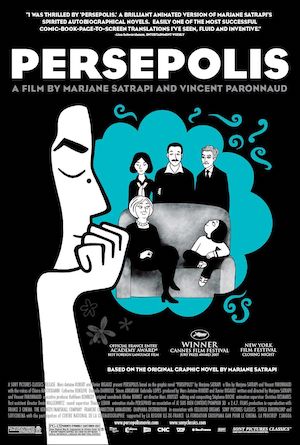
Persepolis (2007)
Based on the autobiographical graphic novel of the same name, Persepolis is the story of Marjane “Marji” Satrapi, who reflects on her life while waiting in a French airport. We follow her through her upbringing in Tehran, the 1979 Iranian Revolution, the Iran-Iraq war, her departure to Vienna, her return to Iran and her eventual self-exile. Through all this Marji encounters oppression, discrimination, apathy, depression, and self-discovery.
Persepolis shows the social consequences of an extremist governmental response to revolution and war. After initially being supportive of the potential changes brought about by the new regime, young Marji quickly becomes disillusioned as she and her female relatives are forced to wear increasingly modest and restrictive clothing, and friends and family members are taken away and executed for their “dissident” beliefs. The black and white art style lends itself very well to this – a deliberate choice by Satrapi to encourage the viewer to see regular people living in their home country, as opposed to foreigners in a foreign country. A sobering meditation on cultural identity.

Sword of the Stranger (2007)
A boy and his dog, who are in hiding from the Ming Emperor, happen to meet a wandering swordsman with no memory of his past, and hire him as a bodyguard. When it becomes known that the boy’s blood can supposedly be used to create an elixir of immortality, more parties enter the fray, culminating in an epic battle between two armies both intent on sacrificing the boy.
There are some well-worn anime tropes at play here: feudal Japan, a masterless swordsman, a touch of the fantastical, epic fight scenes … None of these are downsides, by the way. The action is very well executed, the story is compelling, and it’s very palatable for those who are new to the anime style, which makes it a great gateway film for those looking to get into the genre.

Funan (2018)
During the Khmer Rouge, Chou, a mother living with her children and extended family in Phnom Penh, is separated from her 4-year-old son Sovanh and his grandmother by the revolutionaries. As she and the rest of her family endure extreme hardship and death, Chou attempts to survive long enough to find Sovanh before it’s too late.
The main protagonist, Chou, is based on writer/director Denis Do’s memories of his own mother, which gives the emotional weight of Funan a very personal touch. Not that it isn’t emotional enough already; a child being separated from their parents is one of the most agonising concepts there is. The backdrop of the Khmer Rouge and the violence of the regime make this an even more moving and tense animated war film than most.

Giovanni’s Island (2014)
At the very end of World War II, Russian soldiers occupy the island home of brothers Junpei and Kanta, who live with their father and grandfather. When forced out of their home to make space for the Russian commander and his family, they befriend the commander’s daughter, Tanya. However, the boys’ father Tatsuo is arrested and sent to an internment camp. Eventually the Japanese citizens of the island are forced to be relocated, and the boys, with the help of their uncle, learn that their father is alive, and set out to be reunited with him.
This film is very pretty, through the eyes of the young protagonists, the film dips into flights of fantasy that are very colourful and imaginative, and the overall animation style captures the energy of the boys very effectively. As with many films involving WWII and camps, there are some incredibly tragic moments here, but themes of cross-cultural friendship and bonding triumph in the end.
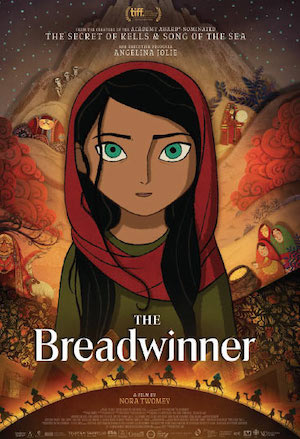
The Breadwinner (2017)
From the Irish studio Cartoon Saloon, which brought us the gorgeous Song of the Sea and The Secret of Kells, comes this equally visually arresting cartoon about war, family, oppression and determination. Parvana lives in Kabul under the control of the Taliban. When her father, the only adult male of the family, is unjustly arrested, she must disguise herself as a boy in order to be able to leave the house and support her remaining family members, as women are forbidden from going outside without an adult male escort.
Almost every character has a lot to endure in this film. The Parvana’s mother suffers at the hands of brutal misogyny, her elder sister gets bargained off in marriage in order to try and gain protection for the family, her friend Shauzia – also posing as a boy in order to move around freely – is trying to escape her abusive father. Even the antagonist Idrees, an angry young recruit into the Taliban who is the reason Parvana’s father was taken to prison, eventually has to face up to the harsh reality of the militants he has aligned himself with.
However, like the other productions of Cartoon Saloon, the animation here looks amazing, especially during sequences when Parvana entertains her young brother with a story, and the animation changes into an even more gorgeous style of cut-out paper puppets. This is an excellent choice for those looking to introduce their older children to dark kids movies that address real world issues.
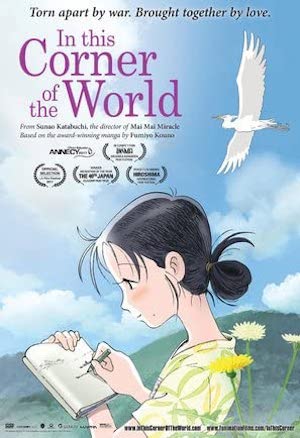
In this Corner of the World (2016)
In 1943, Suzu, a young woman living in a seaside town near Hiroshima, agrees to get married and moves in with her new family. As the Pacific War begins to cause food shortage problems and rationing is implemented, Suzu maintains her cheerful demeanour. But eventually time rolls around to August 6th, 1945, and Suzu and her family suffer immense tragedy at the hands of the Allied bombings.
The power of this particular animated war movie comes from the balance between the build-up, and the payoff, so to speak. In the first half we get lovingly recreated snapshots of 1930’s and early 40’s Japan, with Suzu going about her daily activities and drawing pictures. Then, this is counterpointed by the effects of the atomic bombing of Hiroshima and the cataclysmic effects it had on the city and its people. The preceding innocence really hammers home the tragedy of the aftermath, making for a powerful viewing experience.
The film is based on the manga of the same name.
Buy In this Corner of the World
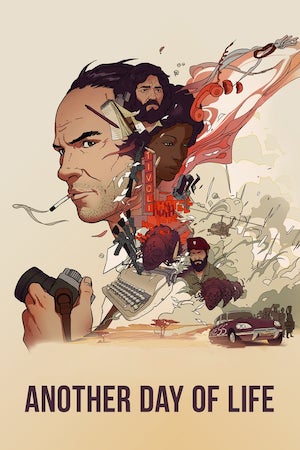
Another Day of Life
Another Day of Life is based on the non-fiction book of the same name by Polish writer Ryszard Kapuściński. It covers a three-month period as Kapuściński travels through Angola during the Angolan Civil War, which began in 1975.
If you want to know what it’s like to be a journalist on the forefront of escalating conflict, this is a good window into that world. The animation is rotoscoped, meaning that each frame of film was hand traced and drawn over by animators and then blended together to make fluid motion (the most well-known rotoscoped movie is probably 2006’s A Scanner Darkly with Keanu Reeves). This gives the film a sense of heightened reality, and often times means animators can play with what was originally in the frame and take more artistic licence with how they show events. For Another Day of Life, that means that the tension of imminent conflict can be precisely controlled to great effect, which can make for a thrilling experience.